
Is the Zapya file transfer app still worth installing in 2026?
Yes, for one specific job: moving big files between an Android phone, an iPhone and a computer without the internet, a cable or a cloud account. Zapya is still maintained — version 7.1.1 reached Google Play on 1 November 2026 — it is free with ads, and it has been installed more than 280 million times. But the 7.1 redesign has drawn complaints, and single-ecosystem owners already have a better built-in tool.
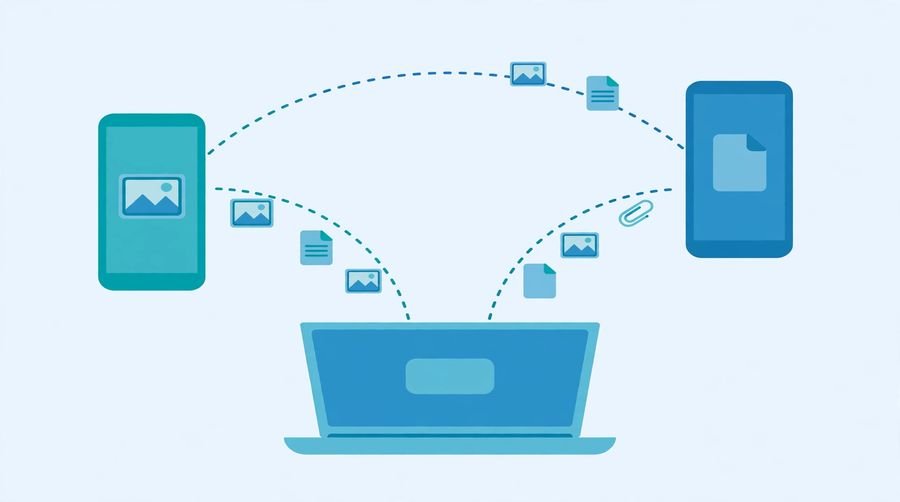
Made by Dewmobile USA, Inc., Zapya works on Android, iOS, Windows and Mac, plus any device with a web browser. It sends files of any size and format directly between devices over a local Wi-Fi connection, using no mobile data and needing no Wi-Fi network. It fills the gap between two phones that cannot talk to each other, most often an Android phone and an iPhone.
One confusion first: there are two Zapya apps on Google Play. This post is about the main app, Zapya – File Transfer, Share. The second, Zapya WebShare, is a smaller companion app with about 12 million installs, last updated in July 2025. Download sites mix the two up, and the top search result for this topic is actually about WebShare.
What does the Zapya file transfer app actually do?
Zapya moves files directly from one device to another over a local wireless connection. Photos, videos, music, documents, folders and even whole apps can be sent, and the maker’s store listing says there is no limit on file size or file type. Because the transfer never goes through the internet, it works on a plane or anywhere your data plan does not reach.
For nearby transfers there are four ways to connect: create a group, generate a personal QR code, shake both phones, or use the radar view to find people around you. Group sharing supports up to four devices at once, and the QR code is the simplest route: the other person just points their camera at your screen. Zapya Transfer, the online mode, sends files to anyone in the world through a web browser, and the recipient does not need the app.
Beyond transfers, Zapya can copy a whole phone’s content onto a new handset, connect a USB drive to view and send files from it, and share apps in APK and AAB formats — known as side-loading.
How fast is Zapya, really?
The maker’s App Store description claims speeds of up to 10 MB per second, or up to 260 photos in a minute. That is the only speed figure from an official listing, and it is a maximum, not a promise: real speed depends on the two devices, the files, and the wireless conditions around you.
Zapya is often described as many times faster than Bluetooth, but the sources disagree: one download site says 100 times faster, another says 200 times. Neither figure comes from a measured test, and the maker does not publish one, so treat both as marketing language. User feedback is mixed too. The app holds about 4.7 stars from roughly 1.2 million Google Play reviews, yet recent reviews of the 7.1 update report slow or stuck transfers, especially between Android and iPhone. Keep both devices awake and close together during a transfer, and check the file on the receiving device before deleting the original.
Is Zapya free, and what do the ads cost you?
Zapya is free to download and free to use, with every file-sharing feature included. The trade-off is advertising: the free version shows ads, and several reviewers describe them as heavy enough to interrupt transfers. That is how the app pays for itself, and why it feels less clean than AirDrop or Quick Share, which have no ads.
There are in-app purchases, and some review sites describe a premium option that removes ads, but no verified US price for it could be confirmed for this post. One comparison site lists $0.72 per item, but that could not be verified against the US store listing, so it is not quoted here as a fact. There is no paid tier that adds transfer features — the free version already does the whole job, and paying only removes the ads.
Is Zapya safe and private?
Transfers happen directly between your devices over a local connection, not through a cloud server, so your files are not uploaded to the maker or stored on its servers in transit. But three things deserve attention before you install it.
First, permissions. Zapya needs broad access to storage and location, to read files and discover nearby devices. Apple’s privacy labels say the iOS version may collect usage data and diagnostics for tracking, plus contact info, contacts and diagnostics linked to your identity. The App Store listing also warns it may use your location even when it is not open.
Second, app sharing. Receiving and installing an app from another person is called side-loading, and it bypasses the safety checks of the Play Store and App Store. A transferred app file could be modified or fake, so only accept apps from people you trust.
Third, the official privacy policy link given in the Google Play listing could not be opened when checked on 24 November 2026 — it returned a not-found error. That does not prove the app mishandles data, but it is a real gap for a file-sharing app. No claim of end-to-end encryption could be found in any official source either, so do not assume your files are encrypted in transit. For sensitive files, a cloud service with encryption or a direct cable is safer — see our guide to the 8 best free cloud storage platforms.
How does Zapya compare with AirDrop, Quick Share and SHAREit?
The built-in tools win on convenience and privacy; Zapya and SHAREit win on working across different kinds of devices. If everyone uses Apple devices, AirDrop is better: built in, no ads, no setup. If everyone uses Android, Quick Share — rebranded from Nearby Share by Google in 2024 — is better for the same reasons. Zapya only earns its place when the devices are mixed, or when there is no internet and no cable handy.
| App | Works on | Needs internet? | Price | Best for |
|---|---|---|---|---|
| Zapya | Android, iOS, Windows, Mac, web browser | No for nearby transfers | Free with ads; in-app purchases | Android to iPhone or phone to PC without internet |
| AirDrop | Apple devices only | No | Free, no ads | iPhone to iPhone, iPad or Mac |
| Quick Share (formerly Nearby Share) | Android, Chromebook; limited iPhone support via web link | No for nearby transfers | Free, no ads | Android to Android, built into the phone |
| SHAREit | Android, iOS, Windows, Mac | No for nearby transfers | Free with ads | Offline transfers where it is already popular |
SHAREit is Zapya’s closest rival: the same offline, cross-platform job, also free with ads, and with over a billion downloads even more widely installed. Zapya is lighter and generally described as the more privacy-conscious of the two. Neither is a clear winner on speed, so the choice mostly comes down to which one the people around you already have.
Should you use the Zapya file transfer app in 2026?
Zapya is worth keeping on your phone if you regularly move files between different kinds of devices, especially Android and iPhone, and you often do it somewhere with no internet. It is still maintained, still free, still fast when it works, and its offline transfer is something neither AirDrop nor Quick Share can do across platforms.
It is not worth installing if you only share files inside one ecosystem. An iPhone owner who only sends to other iPhones gains nothing from Zapya and gets ads and extra permissions in return, and the same goes for Android-only sharing. If the people you share with are far away, a cloud storage link is simpler, because the recipient can open it without installing anything.
Two warnings. First, the 7.1 update redesigned the interface, and recent reviews call it confusing and report missing features, including the old Hide Apps option, plus stalled transfers — test it with a small file first. Second, skip app sharing unless you fully trust the sender, and do not send sensitive documents through it while its privacy policy page is unreachable. If Zapya is not for you, our roundup of the best free apps for Android and iOS has other free utilities worth having.
Zapya file transfer app: Frequently Asked Questions
Is the Zapya file transfer app still available in 2026?
Yes. It is still on Google Play and the App Store: version 7.1.1 was released for Android on 1 November 2026, and the app has more than 280 million installs. The iOS listing shows an older version, 6.5.0, so Android is currently ahead on updates.
Does Zapya need the internet to transfer files?
No, not for nearby transfers. Zapya creates a direct local wireless connection, so it works without Wi-Fi or mobile data. Its online mode, Zapya Transfer, sends files through a web browser to anyone in the world — that mode needs the internet, and the recipient does not need the app.
Is Zapya free?
Yes. It is free to download and use, with every file-sharing feature included. The free version shows ads, and there are in-app purchases, described by reviewers as a premium ad-free option, but no verified US price could be confirmed. Paying removes ads; it does not add transfer features.
Can Zapya transfer files between Android and iPhone?
Yes, that is its main strength. Zapya works on Android, iOS, Windows and Mac, so it can move files between an Android phone and an iPhone, which AirDrop and Quick Share cannot do directly. Some users of the 7.1 update report stalled transfers, so test it with a small file first.
Is Zapya safe to use?
Mostly, with two cautions. Transfers go directly between devices rather than through a cloud server, which is good for privacy, but the app asks for broad permissions including location and storage, and Apple’s privacy labels show it may collect usage data, diagnostics and contact information. Never install an app file from a stranger, and avoid sensitive documents while its privacy policy page is unreachable.
Sources checked 24 November 2026: Google Play listing for Zapya – File Transfer, Share (Google Play), Apple App Store listing for Zapya – File Sharing (version 6.5.0, privacy labels, seller Lindong Network Technology (Beijing) Co., Ltd.), AppBrain data (280 million installs, 4.65 stars, version 7.1.1, updated 1 November 2026), Uptodown version history, FileHorse Zapya for PC page, and comparison coverage from Techtippr, SlashGear, EaseUS and Wondershare. Speed figures are the maker’s own claims from the App Store listing; the 100x and 200x faster-than-Bluetooth figures conflict between sources and are not from a measured test. The official privacy policy link on Google Play (zapya.app/policy_en.html) returned a not-found error when checked.