
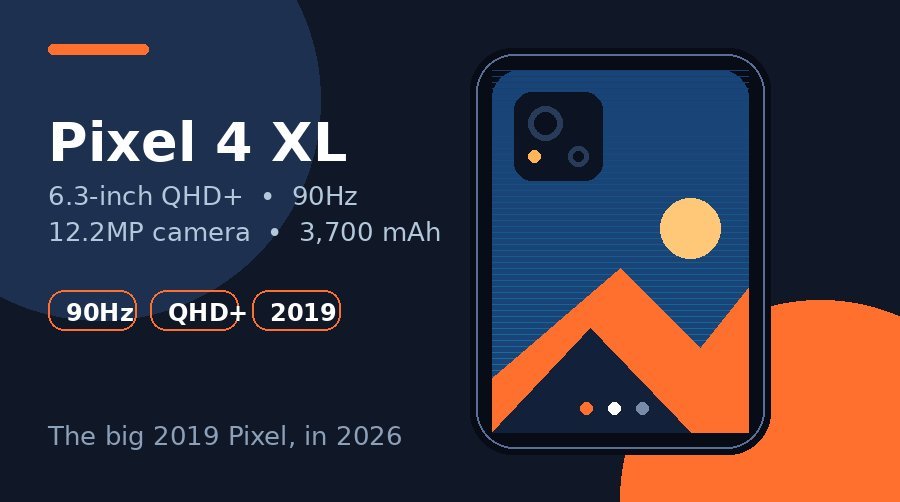
Is the Google Pixel 4 XL still worth buying in 2026?
For most people, the answer is no as a main phone, and yes only as a cheap second phone or camera. The Google Pixel 4 XL still takes good daylight and night photos, and its 6.3-inch QHD+ 90Hz OLED screen looks sharp and smooth. But Google ended its guaranteed updates in October 2022, it stops at Android 13, and it has no 5G or fingerprint sensor. At a typical used price of about $112 in the US, it can make sense for light use. Above about $150, it does not.
Google announced the Pixel 4 XL on October 15, 2019, and it went on sale in the US on October 24, 2019, starting at $899 for 64GB and $999 for 128GB. It came in Just Black, Clearly White, and Oh So Orange, and Google discontinued it in August 2020. It was the first Pixel with two rear cameras, the first with a radar chip for hand gestures, and the first Pixel with no fingerprint sensor at all.
What are the Google Pixel 4 XL specs?
Inside, the Pixel 4 XL runs on the Qualcomm Snapdragon 855 with 6GB of LPDDR4X RAM and either 64GB or 128GB of storage, with no way to add more. It also has Google Pixel Neural Core and the Titan M security chip. Connectivity covers Wi-Fi 5, Bluetooth 5.0, NFC, and USB-C, with a nano-SIM plus eSIM. There is no 5G.
The full Pixel 4 XL specifications on GSMArena list the same core hardware, including Android 10 at launch and Android 13 as the last major update, and the model numbers include G020P. The table below gives the figures that matter when you compare a used unit with a newer budget phone.
| Specification | Google Pixel 4 XL |
|---|---|
| Display | 6.3-inch P-OLED, 1440 x 3040, 537 ppi, up to 90Hz, HDR, Gorilla Glass 5 |
| Processor and RAM | Qualcomm Snapdragon 855, 6GB LPDDR4X RAM, Pixel Neural Core, Titan M chip |
| Storage | 64GB or 128GB UFS 2.1, no microSD slot |
| Rear cameras | 12.2MP main, f/1.7, OIS + 16MP telephoto, f/2.4, 2x optical zoom |
| Front camera | 8MP, f/2.0, 90-degree field of view, plus a time-of-flight sensor |
| Battery and charging | 3,700mAh, non-removable, 18W wired charging, 11W Qi wireless charging |
| Software | Android 10 at launch, upgradable to Android 13, updates ended October 2022 |
| Security | Face Unlock only, no fingerprint sensor, Soli radar Motion Sense |
| Build and size | 160.4 x 75.1 x 8.2 mm, 193 g, glass and aluminium, IP68 rated |
| Launch price in the US | $899 for 64GB, $999 for 128GB, on sale October 24, 2019 |
How is the Pixel 4 XL different from the Pixel 4?
The Pixel 4 XL is the bigger sibling of the Google Pixel 4, and the differences are almost all about size, screen, and battery. The XL has a 6.3-inch QHD+ display at 1440 x 3040, while the smaller phone has a 5.7-inch FHD+ display at 1080 x 2280. Both screens run at up to 90Hz, but the XL screen is sharper, with 537 pixels per inch against 444, and it is easier to read, watch video on, and type on.
The battery is the other real difference. The XL has a 3,700mAh battery, while the Pixel 4 has only 2,800mAh, a cell that was small even in 2019. That 900mAh gap is the main reason to pick the XL over its smaller sibling, which often needs a top-up by the afternoon.
Everything else is the same. Both phones share the Snapdragon 855 chip, 6GB of RAM, the same 12.2MP main camera with a 16MP telephoto lens, the same Soli radar chip and Face Unlock, and the same Android 13 final version. If you want a small phone, the Pixel 4 is the better pick. If you want the bigger screen and the bigger battery, the XL is the one to buy, and it usually costs only about $20 more used.
How good is the Pixel 4 XL display in 2026?
The display is still one of the best reasons to buy this phone. The 6.3-inch P-OLED panel is sharp, bright enough for outdoor use, and smooth at 90Hz, which makes scrolling feel far more modern than the 60Hz screens on many budget phones. The QHD+ resolution keeps text crisp, and HDR support helps video look richer.
How good is the Google Pixel 4 XL camera in 2026?
The camera is the best reason to buy a Pixel 4 XL in 2026. It was Google first dual rear camera: a 12.2MP main camera with an f/1.7 lens, optical image stabilisation, and dual-pixel autofocus, plus a 16MP telephoto camera with an f/2.4 lens and 2x optical zoom. The phone records 4K video at 30 frames per second.
What makes the photos hold up is Google processing. Night Sight brightens very dark scenes by combining several exposures, and the Pixel 4 XL added an astrophotography mode that can photograph stars when the phone is held still in near darkness. Live HDR+ shows in the viewfinder what the finished photo will look like. The front camera is an 8MP sensor with a wide 90-degree field of view.
In daylight, a Pixel 4 XL still produces clean, well-balanced photos, and at night Night Sight remains a real advantage over most phones near its used price. The limits are the ones you would expect from 2019: no ultra-wide rear camera, no 4K at 60 frames per second, and a telephoto lens that only reaches 2x optically.
How long does the Pixel 4 XL battery last?
Longer than the Pixel 4, but still not long by 2026 standards. The battery is 3,700mAh, which was average when the phone launched and is small now, when even budget phones commonly ship with 5,000mAh. On a used unit in 2026, expect noticeably less than a new one gave.
For light use, calls, messages, some browsing, and a few photos, mostly on Wi-Fi, a healthy used Pixel 4 XL can still get through a working day. For heavy use, such as navigation or video streaming, plan on charging by the evening. If the phone drops sharply from 30% to zero, walk away, because that points to a worn-out cell.
There is one more battery warning, and it matters more for the XL than for the smaller phone. Reports of swelling batteries and peeling back panels were concentrated on the larger Pixel 4 XL, with owners reporting the rear glass lifting at a corner. Google investigated and said it was not a battery swelling problem, and no formal recall was found. Never buy a phone with a lifting back panel: a swollen battery is a fire risk, and a lifted back also means the phone is no longer water resistant.
Does the Google Pixel 4 XL still get updates?
No. Google promised three years of Android version and security updates for the Pixel 4 XL, and it kept that promise. The phone launched on Android 10, received Android 11, 12, and 13, and then stopped. The October 2022 security update was the last guaranteed update, and Android 13 is the last major Android version it will ever run.
Google Play Services and individual apps still update, so the phone does not stop working overnight, and most everyday apps still run on Android 13. But banking and payment apps are usually among the first to require a newer, patched system, and that is the real risk of using an unsupported phone as your main device.
What happened to Soli, Motion Sense, and Face Unlock?
The Pixel 4 XL is one of only two Pixels ever made with Google Soli radar chip. Soli powers Motion Sense, which lets you skip songs, silence alarms, and mute calls with a wave of your hand. The same radar wakes the phone as you reach for it and starts Face Unlock. There is no fingerprint sensor at all.
How much does a used Google Pixel 4 XL cost in the US in 2026?
Expect to pay about $112 for a used Google Pixel 4 XL in the US, as a guide checked on November 23, 2026. That figure comes from Techfare, which tracked 34 sold listings in the last 30 days and reported an average used sale price of about $112, with most sales between $70 and $177: about $96 for 64GB and about $127 for 128GB.
Asking prices run a little higher than sold prices, so use sold prices when you negotiate. A clean 128GB unit is worth more than a scratched 64GB unit, and an unlocked phone is worth more than one tied to a carrier. Do not pay more than about $150 for a clean 128GB unit, or about $120 for a clean 64GB unit.
Should you buy a Pixel 4 XL or a newer Pixel instead?
For most buyers in 2026, a newer used Pixel is the better spend. The Pixel 8, for example, is listed by resellers at around $180 and up in certified used condition, and it was the first Google phone with a seven-year software support commitment, giving buyers support until around 2030. That is roughly $70 more than a typical used Pixel 4 XL for a phone that is four years newer, with 5G and years of updates left.
The Pixel 4 XL still wins on price and on its screen. At about $112, it is one of the cheapest ways to get Google camera processing and a sharp 90Hz QHD+ OLED screen. If you want a second phone, a travel phone, or a camera, and $112 is your ceiling, the XL is a fair choice. If you can stretch to $180, the newer Pixel is the wiser spend.
A phone such as the Samsung Galaxy A12 gives you a much larger battery, but its camera cannot match the Pixel 4 XL in low light. The Apple iPhone 11, from the same year, also has no 5G, but Apple supported it for longer than Google supported the Pixel 4 XL.
What should you check before you buy a used Google Pixel 4 XL?
Check the phone on Android 13, confirm the model numbers include G020P, and check that the IMEI is clean. Look for a lifting back panel, charge the phone to full, and watch for a sudden drop. Test both cameras, the flash, and Night Sight, plus Face Unlock, the screen, calls, Wi-Fi, Bluetooth, NFC, and the USB-C port. Finally, buy where you have buyer protection, such as eBay or Swappa, rather than paying cash with no receipt.
Frequently asked questions about the Google Pixel 4 XL
Is the Google Pixel 4 XL still worth buying in 2026?
Only as a cheap second phone or camera, not as a main phone. Its camera and QHD+ 90Hz screen still hold up, and a typical used price of about $112 in the US is fair. But updates ended in October 2022 and it has no 5G.
What is the last update for the Google Pixel 4 XL?
The last guaranteed update was the October 2022 security update, and Android 13 is the last major Android version for the phone. Some pages wrongly say support ended in 2023; that date belongs to the later Pixel 4a, not the Pixel 4 XL.
How much is a used Google Pixel 4 XL worth in the US?
About $112 on average, as a guide checked on November 23, 2026, from 34 sold listings tracked by Techfare, with most sales between $70 and $177. The 64GB model averaged about $96 and the 128GB model about $127.
Does the Google Pixel 4 XL have a fingerprint sensor?
No. The Pixel 4 XL has no fingerprint sensor at all. It unlocks with Face Unlock, powered by the Soli radar chip and a time-of-flight camera in the wide top bezel, and that is the only biometric option.
Is the Google Pixel 4 XL battery a problem?
Yes, in two ways. First, the 3,700mAh battery is small by 2026 standards, so a seven-year-old unit will not last a full heavy day. Second, swelling and peeling back panels were reported, mostly on the larger Pixel 4 XL, with the cause disputed: a repair-chain manager blamed faulty battery connectors, while Google said it was not battery swelling. No formal recall was found.
The Google Pixel 4 XL is a good camera in a bigger body with a battery and an update clock that have both run out. Buy it for about $112 or less, as a second phone or a camera, after checking the battery, the back panel, Face Unlock, and both cameras.