
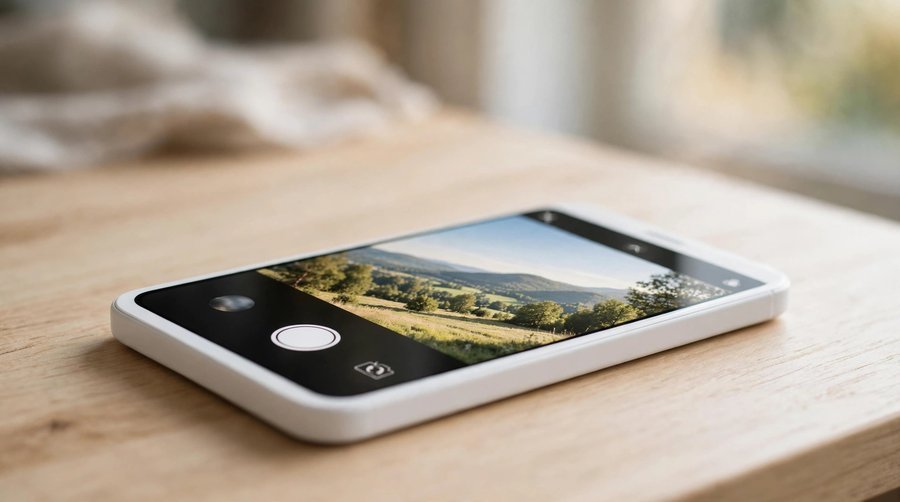
Is the Google Pixel 4 still worth buying in 2026, or is a seven-year-old flagship now too old to trust as a daily phone?
For most people, the answer is no as a main phone, and yes only as a cheap second phone or camera. The Google Pixel 4 still takes very good daylight and night photos, its 5.7-inch 90Hz OLED screen still feels smooth, and it is small and light at 162 grams. But Google ended its guaranteed updates in October 2022, it stops at Android 13, and its 2,800mAh battery was small even in 2019. At a typical used price of about $91 in the US, it can make sense for light use. Above about $120, it does not.
Google announced the Pixel 4 on October 15, 2019, and it went on sale in the US on October 24, 2019, starting at $799 for 64GB and $899 for 128GB. It came in Just Black, Clearly White, and the limited-edition Oh So Orange, and Google discontinued it in August 2020. It was the first Pixel with two rear cameras, the first with a radar chip for hand gestures, and the first Pixel with no fingerprint sensor.
What are the Google Pixel 4 specs?
Inside, the Pixel 4 runs on the Qualcomm Snapdragon 855 with 6GB of LPDDR4X RAM and either 64GB or 128GB of storage, with no way to add more. It also has Google’s Pixel Neural Core and the Titan M security chip. Connectivity covers Wi-Fi 5, Bluetooth 5.0, NFC, and USB-C, with a nano-SIM plus eSIM. There is no 5G. The full Pixel 4 specifications on Wikipedia list the same core hardware, including Android 10 at launch and Android 13 as the last major update, and the model numbers include G020M.
| Specification | Google Pixel 4 |
|---|---|
| Display | 5.7-inch P-OLED, 1080 x 2280, 444 ppi, up to 90Hz, HDR, Gorilla Glass 5 |
| Processor and RAM | Qualcomm Snapdragon 855, 6GB LPDDR4X RAM, Pixel Neural Core, Titan M chip |
| Storage | 64GB or 128GB UFS 2.1, no microSD slot |
| Rear cameras | 12.2MP main, f/1.7, OIS + 16MP telephoto, f/2.4, 2x optical zoom |
| Front camera | 8MP, f/2.0, 90-degree field of view, plus a time-of-flight sensor |
| Battery and charging | 2,800mAh, non-removable, 18W wired charging, 11W Qi wireless charging |
| Software | Android 10 at launch, upgradable to Android 13, updates ended October 2022 |
| Security | Face Unlock only, no fingerprint sensor, Soli radar Motion Sense |
| Build and size | 147.1 x 68.8 x 8.2 mm, 162 g, glass and aluminium, IP68 rated |
| Launch price in the US | $799 for 64GB, $899 for 128GB, on sale October 24, 2019 |
For everyday work — calls, messages, email, maps, YouTube, and the camera — the Snapdragon 855 and 6GB of RAM still cope. Demanding games or many apps open at once will slow it down.
How good is the Google Pixel 4 camera in 2026?
The camera is the best reason to buy a Pixel 4 in 2026. It was Google’s first dual rear camera: a 12.2MP main camera with an f/1.7 lens, optical image stabilisation, and dual-pixel autofocus, plus a 16MP telephoto camera with an f/2.4 lens and 2x optical zoom. Google’s Super Res Zoom sharpens zoomed shots beyond 2x, and the phone records 4K video at 30 frames per second.
What makes the photos hold up is Google’s processing. Night Sight brightens very dark scenes by combining several exposures, and the Pixel 4 added an astrophotography mode that can photograph stars when the phone is held still in near darkness. Live HDR+ shows in the viewfinder what the finished photo will look like, and dual exposure controls let you adjust brightness and shadows separately. The front camera is an 8MP sensor with a wide 90-degree field of view.
In daylight, a Pixel 4 still produces clean, well-balanced photos, and at night Night Sight remains a real advantage over most phones near its used price. The limits are the ones you would expect from 2019: no ultra-wide rear camera, no 4K at 60 frames per second, and a telephoto lens that only reaches 2x optically. Before you pay, test the camera and check that the lenses are clean and the autofocus locks quickly.
How long does the Google Pixel 4 battery last?
Not long, and this is the Pixel 4’s biggest weakness. The battery is 2,800mAh, which was small when the phone launched and is tiny by 2026 standards, when even budget phones commonly ship with 5,000mAh. The Pixel 4 had a smaller battery than the Pixel 3 it replaced, which had 2,915mAh. On a used unit in 2026, with seven years of wear on the same cell, expect noticeably less than a new one gave.
For light use — calls, messages, some browsing, and a few photos, mostly on Wi-Fi — a healthy used Pixel 4 can still get through a working day. For heavy use, such as navigation or video streaming, plan on charging by the afternoon. The phone charges at 18W over USB-C and supports 11W Qi wireless charging. If the phone drops sharply from 30% to zero, walk away.
Reports of swelling batteries and peeling back panels were concentrated on the larger Pixel 4 XL, not the standard Pixel 4. Owners reported the rear glass lifting at a corner, and a manager at the repair chain uBreakiFix blamed faulty battery connectors. Google investigated and said it was not a battery swelling problem, and no formal recall was found. Never buy a phone with a lifting back panel: a swollen battery is a fire risk, and a lifted back also means the phone is no longer water resistant.
Does the Google Pixel 4 still get updates?
No. Google promised three years of Android version and security updates for the Pixel 4, and it kept that promise. The phone launched on Android 10, received Android 11, 12, and 13, and then stopped. The October 2022 security update was the last guaranteed update for the Pixel 4 and Pixel 4 XL, and the phones were left out of the November 2022 update list. Android 13 is the last major Android version it will ever run.
Google Play Services and individual apps still update, so the phone does not stop working overnight, and most everyday apps still run on Android 13. But banking and payment apps are usually among the first to require a newer, patched system. Some pages wrongly say support ended in 2023, but the last guaranteed update was October 2022.
What happened to Soli, Motion Sense, and Face Unlock?
The Pixel 4 is the only Pixel ever made with Google’s Soli radar chip. Soli powers Motion Sense, which lets you skip songs, silence alarms, and mute calls with a wave of your hand. The same radar wakes the phone as you reach for it and starts Face Unlock. There is no fingerprint sensor at all.
In practice, Motion Sense was more of a novelty than a daily tool, and Google never brought Soli back to a later Pixel. Face Unlock works well in good light and is fast, but it is less reliable in the dark than a fingerprint sensor, and there is no fingerprint fallback when it fails. If Face Unlock is slow or fails repeatedly, the front sensors may be damaged.
How much does a used Google Pixel 4 cost in the US in 2026?
Expect to pay about $91 for a used Google Pixel 4 in the US, as a guide checked on November 22, 2026. That figure comes from Techfare, which tracked 42 sold listings in the last 30 days and reported an average used sale price of about $91, with most sales between $62 and $120: about $93 for the 64GB model and about $109 for the 128GB model.
Asking prices run a little higher than sold prices. Flipify, tracking 19 listings on eBay and Facebook Marketplace since November 2, 2026, reported a median asking price of $110, with most listings between $80 and $130. Use the sold range of $62 to $120 as your guide, and do not pay more than about $120 for a clean 128GB unit. Trade-in values are far lower: Techtree paid $11 to $34 for a Pixel 4 as of November 22, 2026.
Should you buy a Pixel 4 or a newer Pixel instead?
For most buyers in 2026, a newer used Pixel is the better spend. The Pixel 8, for example, is listed by resellers at around $180 and up in certified used condition, and it was the first Google phone with a seven-year software support commitment, giving buyers support until around 2030. That is roughly $90 more than a typical used Pixel 4 for a phone that is four years newer, has 5G, a much larger battery, and years of updates left.
The Pixel 4 still wins on size and price. At 147.1 mm tall and 162 grams, it is smaller and lighter than almost every phone sold in 2026, and it is one of the cheapest ways to get Google’s camera processing and a 90Hz OLED screen. If you want a small phone, a backup, or a camera, and $90 is genuinely your ceiling, the Pixel 4 is a fair choice. If you are thinking about an iPhone instead, read our guide on how to get iOS 26 on your iPhone first. And if you do buy the Pixel 4, start with our list of the best free apps for Android and iOS.
What should you check before you buy a used Google Pixel 4?
Check the phone on Android 13, confirm the model numbers include G020M, and check that the IMEI is clean. Look for a lifting back panel, charge the phone to full, and watch for a sudden drop. Test both cameras, the flash, and Night Sight. Test Face Unlock, check the screen for burn-in and dead spots, and test calls, Wi-Fi, Bluetooth, NFC, and the USB-C port. Ask whether the battery has ever been replaced. Finally, buy where you have buyer protection, such as eBay or Swappa, rather than paying cash with no receipt.
Frequently asked questions about the Google Pixel 4
Is the Google Pixel 4 still worth buying in 2026?
Only as a cheap second phone or camera, not as a main phone. Its camera and 90Hz screen still hold up, and a typical used price of about $91 in the US is fair. But updates ended in October 2022, it stops at Android 13, and its 2,800mAh battery was small even in 2019.
What is the last update for the Google Pixel 4?
The last guaranteed update was the October 2022 security update, version TP1A.221005.002, and Android 13 is the last major Android version for the phone. Some pages wrongly say support ended in 2023; that date belongs to the later Pixel 4a, not the Pixel 4.
How much is a used Google Pixel 4 worth in the US?
About $91 on average, as a guide checked on November 22, 2026, from 42 sold listings tracked by Techfare, with most sales between $62 and $120. The 64GB model averaged about $93 and the 128GB model about $109. Asking prices run higher, with a median of $110, so use sold prices when you negotiate.
Does the Google Pixel 4 have a fingerprint sensor?
No. The Pixel 4 has no fingerprint sensor at all. It unlocks with Face Unlock, powered by the Soli radar chip and a time-of-flight camera in the wide top bezel, and that is the only biometric option. If Face Unlock fails, you fall back to a PIN, pattern, or password.
Is the Google Pixel 4 battery a problem?
Yes, in two ways. First, the 2,800mAh battery is small and was already criticised at launch, so a seven-year-old unit will not last a full heavy day. Second, swelling and peeling back panels were reported, mostly on the larger Pixel 4 XL, with the cause disputed: a repair-chain manager blamed faulty battery connectors, while Google said it was not battery swelling. No formal recall was found.
The Google Pixel 4 is a good camera in a small body with a battery and an update clock that have both run out. Buy it for about $91 or less, as a second phone or a camera, after checking the battery, the back panel, Face Unlock, and both cameras in person.
Sources: specs and launch details via Wikipedia and GSMArena; update end date via Android Authority, Android Central, and 9to5Google; used US prices via Techfare and Flipify, checked November 22, 2026; battery reports via Android Central and Android Authority. Facts verified November 24, 2026.