
What Is a Sleep Cycle Sleep Tracker?
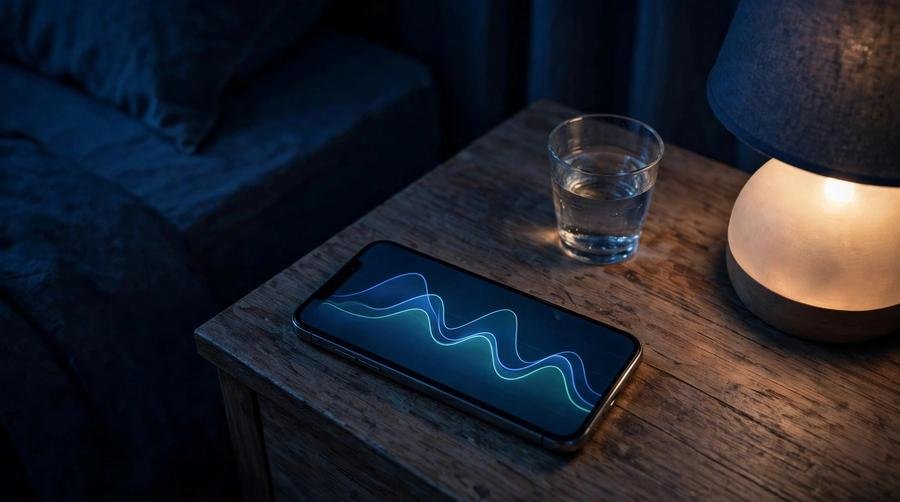
A sleep cycle sleep tracker is an app that sits on your nightstand overnight, listens to the sounds of your sleep, and wakes you during light sleep instead of dragging you out of deep sleep with a fixed alarm. You do not buy any hardware and you do not wear anything to bed: you place your phone face down on the nightstand, or on the mattress beside you, start the session, and go to sleep. In the morning you get a graph of your night, a sleep quality score, and a record of sounds such as snoring or sleep talking. The app is free to download on iPhone and Android, with Premium adding long-term trends, snore recordings, and the full sleep-sound library. The National Council on Aging named it the best sleep tracking app overall in its 2026 testing.
How Does the Sleep Cycle Sleep Tracker Work?
The sleep cycle sleep tracker works by listening. When you start a session, the app uses your phone microphone to pick up breathing sounds and movement noises through the night, and it uses the accelerometer to sense movement if the phone is on the bed. Its software compares those patterns against the patterns of different sleep stages, then draws a curve that estimates when you were awake, in light sleep, in deep sleep, or dreaming. Charge the phone, place it with the microphone pointing toward you, and the app records until you stop it in the morning.
What Does Sleep Cycle Track Each Night?
Every night, the sleep cycle sleep tracker records the shape of your sleep and the sounds around it, then turns that raw material into a morning report you can read in under a minute. The main graph shows your estimated sleep stages across the night: awake, light, deep, and dream sleep, drawn as a single curve from bedtime to waking. Below the graph you get your time in bed, your time actually asleep, your sleep quality score, and a list of detected sounds with timestamps. Premium adds the recordings themselves, so you can play back a short clip of your own snoring or sleep talking. The app also syncs with Apple Health and Google Fit, so your sleep data sits next to your steps and workouts.
| Feature | What you see | Free or Premium |
|---|---|---|
| Sleep stage graph | Awake, light, deep and dream sleep | Free, basic view |
| Smart alarm | Gentle wake-up in a 30-minute window | Free |
| Sleep quality score | Nightly score, time asleep, time in bed | Free, basic view |
| Snore detection | Snoring, coughing, sleep talking flagged | Premium for recordings |
| Long-term trends | Patterns over weeks, with habit notes | Premium |
| Sleep aid sounds | Stories, soundscapes, white noise, meditations | Premium, full library |
| Heart rate tracking | Heart rate via Apple Watch or a device | Premium |
| AI sleep coach Luma | Personal guidance from your patterns | Premium |
How Good Is the Smart Alarm?
The smart alarm is the best thing about Sleep Cycle, and it is the feature most reviewers and most long-term users point to first. Instead of one fixed wake time, you set a latest wake time and a window of up to 30 minutes before it. During that window the app watches for signs of lighter sleep, such as more movement and changes in breathing, and it rings then rather than at the hard deadline. If it never spots light sleep inside the window, the alarm still goes off at the latest time you set, so you are never late. The idea is grounded in real sleep science: waking from light sleep produces far less sleep inertia than waking from deep sleep, and sleep inertia is the heavy, foggy feeling that can linger for 30 minutes or more after a bad alarm.
How Much Does Sleep Cycle Cost in 2026?
Sleep Cycle is free to download, and the free version is genuinely useful rather than a hollow preview. It includes the smart alarm, basic nightly tracking, the sleep graph, and a short history of your recent nights, which is enough to find out whether the app suits you. Premium unlocks the parts that only pay off over time: unlimited history, long-term trend charts, snore and sleep-talk recordings, heart rate tracking, the full sleep aid library, and the AI sleep coach. The official Sleep Cycle website offers a 30-day free trial of Premium, so you can test the paid features for a full month before you spend anything.
Pricing is the one part of this review where the numbers need a careful note, because Sleep Cycle shows different Premium offers in different places. Multiple 2026 reviews report a standard annual price of $39.99 per year, after a rise from $29.99 in May 2026, with a monthly option of $9.99 per month. The US App Store listing shows several Premium offers, including annual plans from $9.99 to $57.99 and a monthly plan at $2.99. On the standard annual plan, $39.99 a year works out to about $3.33 a month, while paying $9.99 every month would cost about $119.88 over a year, three times as much for the same features.
How Do You Set Up Sleep Cycle for the First Night?
Setting up the sleep cycle sleep tracker takes about five minutes. Download the app from the App Store or Google Play, create an account, and answer a short set of questions about your usual bedtime, wake time, and sleep habits, which the app uses to set your first alarm window and your sleep goal. The first night is a test, not a verdict: keep the room quiet, keep the phone uncovered, and do not worry if the graph looks strange.
How Accurate Is the Sleep Cycle Sleep Tracker?
The honest answer is that the sleep cycle sleep tracker gives you useful estimates, not medical measurements. A phone on the nightstand measures sound and movement, and sound and movement are clues about sleep, not direct measurements of it. The clinical standard for sleep staging is polysomnography, a sleep study in a lab that records brain waves, eye movements, and muscle activity with sensors attached to your body. No phone microphone can match that, and independent testing has found that phone-based stage estimates can be off by a wide margin on individual nights, with dream-sleep minutes sometimes landing 20 to 30 percent away from a lab-grade reference.
Accuracy also drops in specific situations that are worth knowing about before you trust the numbers. Sharing a bed is the biggest one, because the microphone picks up your partner’s sounds and the accelerometer picks up their movements, and the app’s software has to guess which signals belong to you. A noisy street, a snoring partner, a pet on the bed, or a phone placed too far away can all blur the data in the same way. If the app shows heavy snoring night after night, pauses in breathing, or extreme daytime sleepiness, take that as a reason to talk to a doctor, not as a diagnosis, because only a sleep study can confirm a condition such as sleep apnea.
What Are the Pros and Cons of Sleep Cycle?
The strengths of Sleep Cycle start with the fact that it asks nothing of you except a phone you already own. There is no ring to buy, no strap to charge, and no sensor to wear, which makes it the easiest sleep tracker to start using tonight. The smart alarm is genuinely better than a fixed alarm for most people, the morning graph is clear enough to read in seconds, and the free version covers the core experience instead of locking it behind a paywall. The weaknesses are the mirror image: because it measures from the nightstand, its sleep stages are estimates, and anyone who wants precise data should look at a wearable instead.
Who Should Use Sleep Cycle, and Who Should Skip It?
Sleep Cycle is a strong fit if you wake up groggy most mornings and want a gentler alarm without buying new hardware. It suits people who are new to sleep tracking and want their data explained in plain language, people who suspect they snore and want proof before they raise it with a doctor, and people who like spotting patterns between their habits and their sleep. Our guide to the best health apps for women covers apps that pair well with a sleep tracker. Gentle evening yoga can help you fall asleep faster, and our roundup of the best free yoga apps includes ten-minute sessions for bedtime. You should skip it if you need precise sleep data for a medical reason, if you already own a smartwatch or ring that tracks sleep from your wrist, or if you share a bed and your partner is a heavy snorer. Athletes who want recovery data, heart rate variability, and blood oxygen readings will get more from a dedicated wearable, and if the alarm does not feel different after two weeks, trust that result and move on.
Frequently Asked Questions About the Sleep Cycle Sleep Tracker
Is the sleep cycle sleep tracker free?
Yes, Sleep Cycle is free to download on iPhone and Android, and the free version includes the smart alarm, basic nightly tracking, the sleep graph, and a short history of recent nights. Premium unlocks unlimited history, long-term trends, snore recordings, heart rate tracking, and the sleep aid library. The standard annual price reported by multiple 2026 reviews is $39.99 per year, with a monthly option of $9.99 per month, but the App Store shows several different Premium offers, so check the exact price on your own checkout screen.
Does Sleep Cycle work without a wearable?
Yes, and that is its main advantage over watch and ring trackers. Sleep Cycle uses your phone microphone and accelerometer to track sleep, so you place the phone on the nightstand or on the mattress and it records through the night with nothing on your body. The trade-off is accuracy: a phone estimates your sleep stages from sound and movement, while a wearable measures from your skin.
Can Sleep Cycle detect sleep apnea?
No, Sleep Cycle cannot detect or diagnose sleep apnea, and no phone app can. The app can record snoring and flag nights where your snoring was heavy or frequent, and that record is genuinely useful to show a doctor. But snoring is only one possible sign of sleep apnea, and only a clinical sleep study can confirm the condition. If the app shows heavy snoring night after night, or you notice pauses in breathing, morning headaches, or strong daytime sleepiness, talk to a doctor rather than treating the app as a diagnosis.
Does the smart alarm really wake you up feeling better?
For many people, yes, because waking from light sleep causes far less grogginess than waking from deep sleep. Sleep Cycle sets a window of up to 30 minutes before your latest wake time and rings when it detects lighter sleep inside that window, then starts softly and rises gently instead of blaring. Testers in 2026 reported clearer mornings on nights the app chose the wake moment. It does not work perfectly every night, especially in a noisy room or a shared bed, so give it a week or two before you decide.
Is Sleep Cycle better than a smartwatch for tracking sleep?
It depends on what you want from tracking. Sleep Cycle is better if you want to start tonight with no new hardware, no charging routine, and no device on your wrist, and its smart alarm and morning graph are easier to read than most watch apps. A smartwatch is better if you want precise sleep stages, heart rate variability, blood oxygen, and recovery scores, because it measures from your skin all night.
If you wake up groggy most mornings, the sleep cycle sleep tracker is worth a free trial, because it is the cheapest experiment in sleep tracking you can run: no hardware, no subscription to start, and a month of Premium to test before you pay. Use the free version for a week, turn on the smart alarm, and notice how your mornings feel before you look at any score. If the mornings improve, try the Premium trial for the trends and the snore recordings, and check the annual price on your own checkout screen before you commit. If the mornings do not change after two weeks, the app has told you something useful too, and a wearable or a talk with your doctor is the better next step.