
When Was MIUI 12 Global Released?
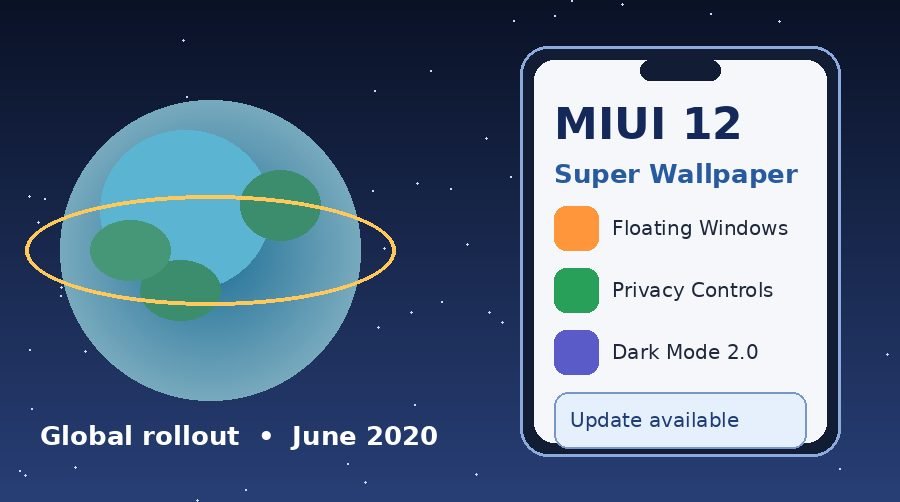
MIUI 12 global released on 19 May 2020, when Xiaomi announced its new Android skin at an online launch event for users outside China. The stable update started rolling out at the end of June 2020, first to the Mi 9, Mi 9T, Mi 9T Pro, Redmi K20, and Redmi K20 Pro, and then to dozens of other Xiaomi, Redmi, and POCO phones in waves through the rest of the year. Built on Android 10, MIUI 12 brought Super Wallpapers, floating windows, stronger privacy controls, a redesigned Control Center, and a new animation system that Xiaomi described as a more lifelike interface.
If you are reading this in 2026, the honest headline is that MIUI 12 is history now. Xiaomi replaced MIUI with HyperOS, announced on 17 October 2023 and first shipped on the Xiaomi 14 series. No new phone ships with MIUI 12, and no phone still on MIUI 12 is getting new features. That does not make the update unimportant. MIUI 12 set the design language that HyperOS still uses, and millions of older Xiaomi, Redmi, and POCO phones never moved past it.
What Is MIUI 12?
MIUI 12 is Xiaomi’s twelfth major version of MIUI, the Android-based interface that runs on Xiaomi, Redmi, and POCO phones. MIUI started in 2010, before Xiaomi even sold its first phone, and it grew into one of the most widely used Android skins in the world. MIUI 12 followed MIUI 11 and was unveiled in China in April 2020 alongside the Mi 10 Lite Zoom Edition, before the global version was announced on 19 May 2020. The global build was based on Android 10, including its navigation gestures, system-wide dark mode, and permission model.
Xiaomi positioned MIUI 12 as a visual and privacy upgrade rather than a small maintenance release. Xiaomi rebuilt the animation system so that opening apps, deleting icons, and charging the phone felt more physical and alive. The update also added an optional app drawer, something long-time MIUI users had asked for, because earlier versions of MIUI put every app icon on the home screen with no drawer at all.
What Did MIUI 12 Bring to Your Phone?
The headline feature of MIUI 12 was Super Wallpapers. These were animated live wallpapers of Earth and Mars, built using official NASA imagery, that zoomed in every time you unlocked your phone. On the lock screen you saw the planet from distant space, and as you unlocked the device the view swept down to a landscape on the surface, such as terraced rice fields or the glaciers of Greenland.
Floating windows were the most useful new feature for multitasking. Instead of switching between apps, you could open a supported app in a small floating window on top of whatever you were doing, then move it, resize it, minimize it, or close it with gestures. You could reply to a message without leaving a video, or look up information while a video kept playing. They worked with most of Xiaomi’s system apps and with popular third-party apps including Netflix, TikTok, and Facebook.
Privacy was the other big theme of the release. MIUI 12 added app behavior records, a log that showed which apps had accessed sensitive permissions and notified you when an app tried to do something unusual. Permissions could be granted only while an app was in use, so an app could not quietly read your location or contacts in the background after you closed it. Xiaomi also let you share a photo without its location data attached.
Dark Mode 2.0 used a darker color palette, adjusted contrast automatically to match ambient light, and added wallpaper dimming that simulated the gradual change of light as the sun went down. The redesigned Control Center was split off from the notification shade, with large interactive icons for Wi-Fi, Bluetooth, and mobile data. Smaller additions included Ultra Battery Saver, a built-in casting tool for mirroring your screen, and Focus Mode.
Which Phones Got the MIUI 12 Global Rollout?
The global rollout of MIUI 12 happened in waves, and Xiaomi was open about the order. Round one, at the end of June 2020, covered five phones: the Mi 9, Mi 9T, Mi 9T Pro, Redmi K20, and Redmi K20 Pro. Beta builds started going out the week after the 19 May announcement, and the stable update followed at the end of June.
Round two covered the bulk of the lineup, but Xiaomi never gave it a firm date, saying only that phones would get the update model by model after June. Round three covered the oldest phones on the list. Some reports described the plan as two rounds and others as three, but the order of the phones was consistent. The table below shows the rollout as Xiaomi announced it in May 2020.
| Rollout wave | Timing announced | Phones included |
|---|---|---|
| Round 1 | End of June 2020 | Mi 9, Mi 9T, Mi 9T Pro, Redmi K20, Redmi K20 Pro |
| Round 2 | After June 2020, no fixed date | Mi 10, Mi 10 Pro, Mi 10 Lite, Mi Note 10, Mi 9 SE, Mi 9 Lite, Mi 8, Mi 8 Pro, Mi MIX 3, Mi MIX 2S, Redmi Note 9 series, Redmi Note 8 series, Redmi Note 7 series, POCO F1, POCO X2, POCO F2 Pro |
| Round 3 | Later in 2020, no fixed date | Mi Note 10 Lite, Mi 8 Lite, Mi Note 3, Mi MIX 2, Mi Max 3, Redmi 6 series, Redmi 7 series, Redmi 8 series, Redmi Note 5 series, Redmi Note 6 Pro, Redmi Y2, Redmi Y3, Redmi S2 |
Xiaomi confirmed the update would reach 47 devices across its Mi, Redmi, and POCO lineups, covering phones launched globally from 2018 onward plus a couple of models from 2017. The Mi MIX 3 5G, Xiaomi’s first 5G phone, was not on the list. The oldest phones on the list, the Redmi Note 5 and the Redmi 6 series, were already two to three years old.
What Happened Next: MIUI 13, MIUI 14, and HyperOS
MIUI 12 was followed by MIUI 12.5 in early 2021, a lighter version that Xiaomi said used less memory and fewer background resources. MIUI 13 arrived at the end of 2021, and MIUI 14 in December 2022, each bringing smaller refinements rather than another big redesign. By MIUI 14, the interface had a reputation for bloat, ads in some regions, and slow performance on older phones.
That something was HyperOS. Xiaomi announced HyperOS on 17 October 2023, and it debuted alongside the Xiaomi 14 series on 26 October 2023, succeeding MIUI as the company’s mobile operating system. Xiaomi said HyperOS was based on a deeply evolved Android foundation combined with its own Vela system, and it was designed to unify phones, smart home products, wearables, and cars under one system. The global HyperOS rollout began in the first quarter of 2024, gradually replacing MIUI on existing devices as well as shipping on new ones.
Phones that were already old in 2023, including many MIUI 12-era devices from 2018 and 2019, were not eligible for HyperOS at all, and they stayed on MIUI 12, MIUI 12.5, or MIUI 13. There was never a MIUI 15. HyperOS took its place. XDA Developers covered the original global launch in detail, including the privacy features and the rollout plan, in its report on the MIUI 12 global launch.
Is MIUI 12 Still Safe to Use in 2026?
The honest answer is that a phone still running MIUI 12 in 2026 is past its supported life. Xiaomi’s security updates for the MIUI 12-era phones ended years ago, and the Android version underneath, Android 10 or Android 11 depending on the model, stopped receiving security patches from Google as well. That does not mean the phone stops working. Calls, messages, browsing, and most apps still work, and the phone can still be useful as a second device or a media player. It does mean the phone is more exposed to security risks than a supported device, especially for banking or email.
If you still use a MIUI 12 phone every day, a few steps reduce the risk. Keep your apps updated through the Google Play Store, because app updates are the main source of security fixes once the system itself stops getting them. Use a browser that still receives updates, and avoid installing apps from outside the Play Store. Turn on MIUI 12’s privacy controls, including the app behavior records, so you can see which apps are accessing your permissions. Remove apps you no longer use.
Some newer apps now require Android 11 or later, so a phone stuck on Android 10 will gradually lose access to new versions of some apps. The Play Store will usually offer you the last compatible version, but that version will not get new features either. This slow fade is the real reason to think about replacing a MIUI 12 device. The Google Pixel 4 launched in 2019 with stock Android and received its last major update years ago, yet its software story is simpler to follow because Google’s update policy was public.
What Should You Do If Your Phone Is Still on MIUI 12?
Start by checking exactly what your phone is running. Go to Settings, then About phone, and look at the MIUI version and the Android version. If it says MIUI 12, your phone is on the 2020 release and is very unlikely to receive any further system update. Tap System update once to confirm, and if it tells you that you are on the latest version, that is Xiaomi’s way of saying the phone’s update life is over. Do not trust websites that promise a MIUI 12 phone can be updated to HyperOS with a simple trick, because for the models left behind, there is no official path.
Next, decide what the phone is for. If it is your only phone and you use it for banking, work email, or two-factor authentication, replacing it is the safer choice. A budget phone such as the Samsung Galaxy A12 shows how much support has improved since 2020, because Samsung now promises several years of updates even on its cheapest phones. Before you move on, back up anything that matters. Photos, contacts, and messages should be copied to a cloud account or a computer, because an old phone can fail without warning. The best free apps for Android and iOS include backup and file management tools that make this easier.
Frequently Asked Questions
Was MIUI 12 global released in 2020 or 2021?
MIUI 12 global released in 2020. Xiaomi announced the global version on 19 May 2020 and started the stable rollout at the end of June 2020, first to the Mi 9 and Redmi K20 families. Later versions such as MIUI 12.5 arrived in 2021, which is where the confusion comes from, but the original MIUI 12 global release was 2020.
Which phones got MIUI 12 first?
The first phones to get the MIUI 12 global stable update were the Mi 9, Mi 9T, Mi 9T Pro, Redmi K20, and Redmi K20 Pro, from the end of June 2020. The Mi 9T and Mi 9T Pro are the global names for the Redmi K20 and K20 Pro. Other phones, including the Mi 10 series, the Redmi Note 9 series, and the POCO F1, followed later in 2020.
Does MIUI 12 still get updates in 2026?
No. MIUI 12 no longer receives updates of any kind, and Xiaomi replaced MIUI with HyperOS in late 2023. Phones that were eligible for HyperOS moved to it during 2024 and 2025, while phones that were not eligible stayed on MIUI 12 or a later MIUI version and received no further updates.
What replaced MIUI 12?
HyperOS replaced MIUI. Xiaomi announced HyperOS on 17 October 2023, and it debuted on the Xiaomi 14 series on 26 October 2023. HyperOS is based on Android combined with Xiaomi’s Vela system, and it runs across phones, smart home devices, wearables, and cars. There was never a MIUI 15, because HyperOS took MIUI’s place entirely.
Can I update a MIUI 12 phone to HyperOS?
For most MIUI 12 phones, no, there is no official way to update to HyperOS. Xiaomi chose which models would receive HyperOS, and the MIUI 12-era phones, mostly from 2018 and 2019, were left behind because their support window had closed. Unofficial custom software exists for a few popular models, but it requires unlocking the bootloader and wiping the phone, and it can break banking apps.