
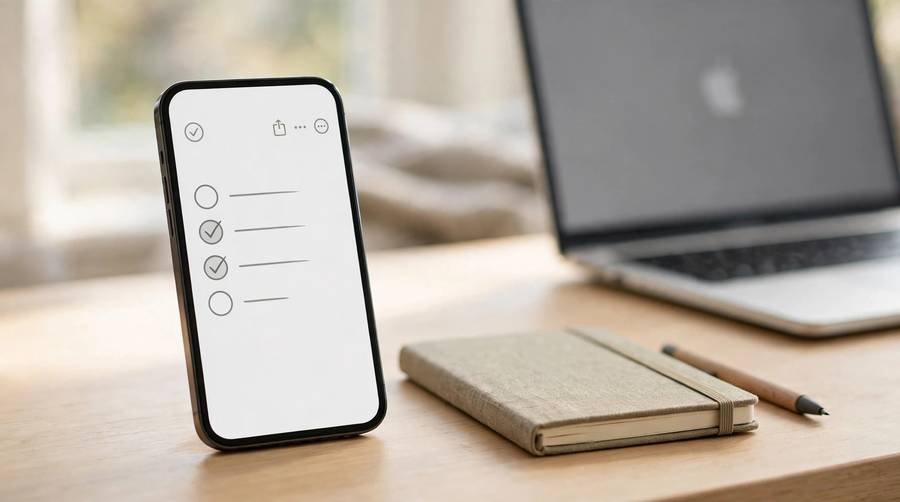
Why do so many people say apple notes is the powerhouse of productivity — and is it really, or is it just the free app that came with your iPhone?
It really is, for most people. Apple Notes is free, already installed on every iPhone, iPad and Mac, and it now records and transcribes audio, solves maths as you type, scans documents, organises notes with folders, tags and Smart Folders, and syncs everything through iCloud. The features that once needed a paid app are now built in, and you do not have to set anything up to start using them.
The trick is that most people only ever use it as a scratchpad. Open a note, type a line, close it. Used that way it looks ordinary. Used as a small system — one place to capture, one place to find, one place to act — it quietly replaces three or four paid apps.
This guide walks through the features that actually change how you work, the honest limits, and a simple setup you can copy in ten minutes. Everything here was checked against Apple’s own documentation and current US pricing on 24 November 2026.
What makes Apple Notes different from a basic notepad?
A notepad stores text. Apple Notes stores text, checklists, tables, photos, scanned documents, drawings, audio recordings with transcripts, links between notes, and shared folders — all in one place, synced across your iPhone, iPad and Mac through iCloud.
The sync is the part people underestimate. Start a note on your phone on the train, finish it on your Mac at your desk, and read it on your iPad in the evening, with no export, no email to yourself, and no third-party account. Apple says iCloud Notes gives you the fullest set of current features, including extra formatting, checklists, tables and media — so the first thing to check is that your notes live in iCloud, not under “On My iPhone” or a Gmail account, where many of those features are missing.
It costs nothing. Apple Notes itself has no price and no paid tier, and every iPhone, iPad and Mac includes 5 GB of free iCloud storage, which is plenty for text notes. If your scans and photos outgrow that, iCloud+ starts at $0.99 a month for 50 GB in the US — but the app itself never asks you to pay.
How do you capture ideas fast in Apple Notes?
Productivity lives or dies on capture speed. An idea you cannot write down in five seconds is an idea you lose, and Apple Notes is built to be the fastest capture tool on an iPhone.
Quick Note is the quickest route. On a Mac, press Fn-Q (or Globe-Q) from any app and a small note opens over what you are doing. On iPhone and iPad, you can start one from the Control Centre or the lock screen, so a thought is captured before it fades. The Share sheet does the same for anything you are looking at — a web page, a photo, an address — sending it straight into a note with a link back to the source.
Siri takes a note hands-free, and dictation turns speech into text inside any note. Document scanning is just as quick: point the camera at a receipt, a whiteboard or a form, and Notes saves it as a PDF you can search later, because scanned text is searchable. A paper document stops being a pile on your desk and becomes a note you can find in seconds.
The rule that makes all of this work is simple: capture first, organise later. A Quick Note is an inbox, not a filing cabinet. Process it the same day — give it a clear title, move it to the right folder, or turn it into a checklist — or the inbox becomes a junk drawer.
How do folders, tags and Smart Folders keep notes findable?
A note you cannot find is a note you never wrote. Apple Notes gives you three ways to organise, and they work best together rather than alone.
Folders are for stable areas of your life: Work, Home, Travel, Health. Keep them broad — a dozen folders you actually use beats forty you never open. Tags are for status and context: add #next to anything waiting for action, #waiting to anything waiting on someone else, #receipt to anything you may need at tax time. One note can carry several tags, so it can live in one folder and still show up in several views.
Smart Folders turn those tags into saved searches. A Smart Folder for #next shows every note tagged #next, whatever folder it sits in, and updates itself as you add or remove tags. It is a filtered view, not a duplicate copy, so nothing gets out of sync.
Two limits are worth knowing. A tagged note cannot be locked, and a locked note cannot receive a tag, so pick one or the other for sensitive notes. And Smart Folders cannot be shared or locked, so they are a personal tool, not a team one.
How do you record and transcribe audio in Apple Notes?
This is the feature that surprises people most. Open a note, tap Attachments, tap Record Audio, and Notes records the meeting, lecture or interview right inside the note — then transcribes the spoken words into searchable text automatically.
On iPhone, audio transcription is available on iPhone 12 and later, when the device language is set to a supported language — English, Spanish, Portuguese, Italian, French, German, Japanese, Korean, Simplified Chinese or Traditional Chinese, according to Apple Support. On a Mac, you need an Apple silicon Mac, M1 or later, with supported language settings. The note should also be stored in iCloud, since Apple identifies iCloud as a requirement for the feature.
You can tap a line of the transcript to replay the audio from that exact point, which makes reviewing a long meeting far quicker than scrubbing through a recording. On supported devices, Apple Intelligence can also summarise the recording — useful for a quick recap, though you should always check a summary against the transcript before acting on anything important, like a deadline or a decision.
The full steps are on Apple’s own page: Record and transcribe audio in Notes on iPhone.
What can Apple Notes do that used to need a paid app?
A few years ago, each of these needed a separate purchase. Today they are all inside the free app.
Maths Notes solves expressions as you type them. Type a calculation anywhere in a note, add an equals sign, and Notes gives you the answer inline — no calculator app, no switching windows. It handles a shopping total, a tip split or a quick budget check without breaking your flow.
Tables turn a note into a small spreadsheet for simple jobs: a packing list with columns, a comparison of two options, a weekly plan. Checklists with tappable circles turn any note into a to-do list, and you can drag items to reorder them or swipe to indent them into subtasks.
Collapsible sections keep long notes readable — fold away the detail and keep the headings visible, so a research note or a project plan reads like a document instead of a wall of text. Text highlighting lets you colour-code passages for review, and links between notes let one note point to another, so a project note can link to the meeting notes behind it.
Locked notes protect sensitive material with a password, Face ID or Touch ID. Shared notes and folders let a small group edit the same note in real time — a household shopping list, a trip plan, a shared set of meeting notes — with no extra app for anyone to install.
How does Apple Notes compare with Notion, Bear and Goodnotes?
Apple Notes wins on price and speed, but it is not the best tool for every job. Here is how it stacks up against the three paid apps people most often compare it with, using current US prices checked on 24 November 2026.
| App | Price (US) | Best for | Where it falls short |
|---|---|---|---|
| Apple Notes | Free, built in | Fast capture, lists, scans and audio notes on Apple devices | Apple-only; no Markdown, no databases, basic export |
| Notion | Free; Plus $10 per user a month billed yearly ($12 monthly) | Team workspaces, databases and linked project pages | Slower to open, weaker offline, overkill for personal notes |
| Bear | Free tier; Pro $2.99 a month or $29.99 a year | Clean Markdown writing on Apple devices | Apple-only; sync and PDF search need the Pro plan |
| Goodnotes | Free tier; Essential $11.99 a year, Pro $35.99 a year | Handwritten notes and PDF annotation with Apple Pencil | Built around handwriting; typed-note users get less value |
The honest test is this: if you cannot name a specific thing Apple Notes will not do for you, do not pay for anything else. The moment you can — Markdown export, a shared database, deep PDF markup, or a workflow that includes Windows or Android — that is the moment a paid app earns its price.
Where does Apple Notes fall short?
No honest guide skips the limits, and Apple Notes has real ones. The biggest is the Apple wall: there is no Windows or Android app, only iCloud.com in a browser, which is slow and has no offline access. If your work crosses platforms every day, Apple Notes will fight you.
There is no Markdown, so you cannot write in plain text and format as you go, and getting notes out is clumsy — export gives you a PDF or plain text per note, not a clean folder of files. PDFs stay attachments you can mark up lightly, not documents you can annotate deeply the way Goodnotes allows.
It is also not a project manager. There are no database views, no Kanban boards, no linked properties, and no due dates or recurring reminders inside a note. Notes handles lightweight checklists well, but anything with a deadline belongs in Reminders — our guide to how to use Apple Reminders shows how the two apps fit together.
Finally, the 5 GB of free iCloud storage is shared with your photos and backups, so heavy scanners will hit the limit. That is a storage bill, not an app bill — but it is the one cost that can creep up on you, starting at $0.99 a month for 50 GB.
How do you set up Apple Notes as a daily productivity system?
You do not need a complicated method. Four stages, repeated daily, are enough: capture, clarify, connect, complete.
Start with three folders: Inbox, Projects and Reference. Everything new lands in Inbox. Once a day, spend five minutes clearing it — give each note a descriptive title, move it to Projects or Reference, add a tag like #next or #waiting, or delete it. A note with a clear title is a note you can find by search alone, and search in Notes covers text, scanned documents, handwriting and audio transcripts.
Connect notes to action with links and checklists. A project note links to the meeting notes and documents behind it; a checklist inside it holds the next steps. When a step has a date, a reminder or a location trigger, move it to Reminders instead of leaving it buried in a note — that handoff is the difference between a note and a system.
Once a week, review your Smart Folders: #next shows what is waiting for you, #waiting shows what is waiting on someone else, and anything with neither tag is either reference or clutter. Archive or delete what is done. The system stays light because you keep clearing it, not because you built a perfect structure on day one.
If you want the bigger picture, our guide to the best note-taking methods compares the systems — from simple lists to linked notes — so you can pick the one that fits how you actually think.
Frequently asked questions about Apple Notes and productivity
Is Apple Notes really free?
Yes. Apple Notes is free and preinstalled on every iPhone, iPad and Mac, with no paid tier and no subscription inside the app. The only cost that can appear is iCloud storage: you get 5 GB free, and paid iCloud+ plans start at $0.99 a month for 50 GB in the US if your scans and photos outgrow it.
Can Apple Notes replace Notion?
For personal notes, lists, scans and meeting notes, yes — and it is faster and free. For team workspaces, databases, Kanban boards or linked project pages, no. Notion Plus costs $10 per user a month billed yearly, and it earns that price only when you actually need its structure.
Does Apple Notes work on Windows or Android?
Only through iCloud.com in a web browser, with no offline access and a slower experience. There is no Windows or Android app. If you switch between Apple and non-Apple devices daily, a cross-platform app like Notion or Obsidian fits better.
How do I find a note I wrote months ago?
Use search — it covers typed text, scanned documents, handwriting and audio transcripts. Descriptive titles help more than folders do, and a small, consistent set of tags like #next and #waiting, gathered in Smart Folders, turns search into a saved view you can open in one tap.
Is my audio transcription private?
Transcription runs on your device within Apple Notes, and locked notes add password, Face ID or Touch ID protection for sensitive material. But shared notes cannot be locked, and locked notes cannot be shared or tagged, so keep confidential recordings in a private, locked note rather than a shared folder.
Apple Notes earns the powerhouse label the honest way: not by doing everything, but by doing the everyday jobs — capture, find, act — faster and cheaper than anything else on your phone. Set up the three folders, clear the inbox daily, and hand dated tasks to Reminders, and the free app you already have becomes the system you stop shopping for.