
What are deepfakes and disinformation, and why should phone users care in 2026?
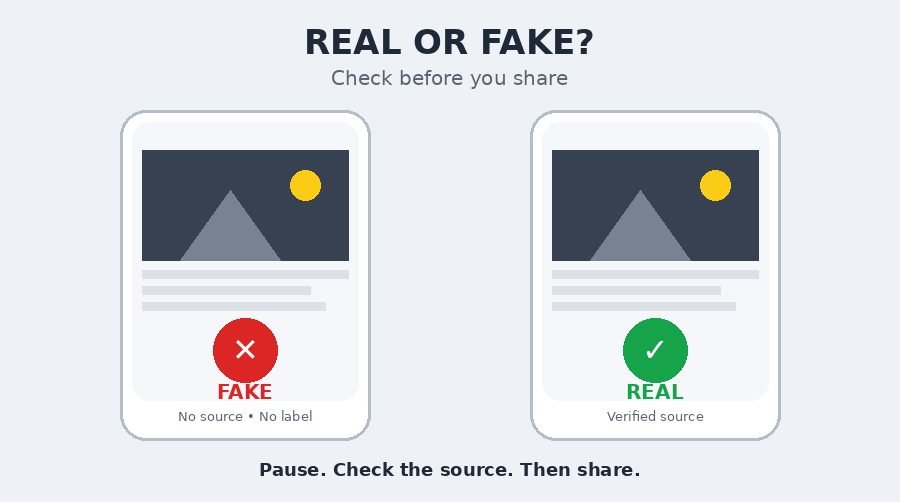
Deepfakes and disinformation are the two halves of the same problem on your phone in 2026. A deepfake is a photo, voice clip or video that artificial intelligence has created or altered so that a real person appears to say or do something they never did, while disinformation is false information spread on purpose to mislead people, and deepfakes have become one of its most convincing delivery methods. You meet both daily: a celebrity promoting a miracle investment, a voice message from a relative in trouble, or a politician announcing something that never happened. None need a studio any more: the tools run on an ordinary phone, and the fakes fool most people at first glance. The starting point is not a trick for spotting every fake by eye, but a habit of checking the source before you believe or share anything surprising.
How are deepfakes made, and how do they reach your phone?
A deepfake is made by training or prompting an AI model on images, video or audio of a real person, then generating new material that copies that person’s face, voice or mannerisms. Modern tools can build a convincing voice clone from a few seconds of audio taken from a public video, and can generate a realistic video from a single photo and a typed script. The Federal Trade Commission warned as early as 20 March 2023 that a scammer needs only a short audio clip of a family member’s voice, the kind that sits in a public video or post, to clone it for a family emergency scam. These apps are often marketed as fun face-swap or voice tools, which is why so many fakes start as something that looks harmless. Once made, a deepfake reaches you like any viral content: a short video on TikTok, Reels or Shorts, a forwarded clip in a family WhatsApp group, a sponsored ad, or a call that sounds like your child.
How can you spot a deepfake video on your phone?
Start with an uncomfortable fact: you probably cannot spot a good deepfake by eye alone. A meta-analysis by Diel and MacDorman, pooling 56 studies in Computers in Human Behavior Reports, found people detect deepfakes at about 55.5 percent overall, barely better than chance. The best fakes of 2026 have few old giveaways, and forwarded videos lose even the flaws they had. Looking is still useful, but it is only the first step, and a clean-looking video is never proof that it is real.
Check several signs together, at full screen and full quality. Look at the edges where the face meets the hair, ears and neck, where generated images most often blur, shimmer or leave a seam, especially when the head turns. Check whether the lighting on the face matches the room. Listen with your eyes closed: cloned voices often sound flat, oddly paced or too clean. Watch the mouth on hard consonants such as p, b and m, where lip-sync errors show most, and look at the teeth, which often blur or merge into one band. Hands, jewelry and background text that melt or garble are common failure points too.
Video calls need a separate test. If a caller asks for money or passwords, ask them to turn their head fully sideways or pass a hand in front of their face. Face-swap tools are trained mostly on head-on shots, so a full head turn often breaks the illusion. If anything feels wrong, hang up and ring the person back on a number you already have saved.
Which deepfake checks actually work, and which ones should you trust?
Not all checks are equal. The table below compares the checks an ordinary phone user can run.
| Check | What it looks at | Cost | How reliable it is in 2026 |
|---|---|---|---|
| Source and spread check | Who posted it first, whether trusted outlets confirm it, and whether the account has a real history | Free | Strongest check; it needs no rendering flaw |
| Reverse image and keyframe search | Whether the same image or frame already exists elsewhere, often with different context or an earlier date | Free, using Google Lens | Strong for reused footage, weak for new generations |
| Content Credentials (C2PA) | A signed record inside the file that says how the media was made, readable at contentcredentials.org/verify | Free | Strong when present, but most viral clips have none |
| Platform AI labels | The “AI info” or “AI-generated” label shown by YouTube, TikTok or Meta | Free | Helpful when shown, but creators can skip it |
| Visual and audio inspection | Face edges, lighting, lip-sync, teeth, hands, background text and voice quality | Free | Supporting evidence only; good fakes show no flaws |
| Automated detector apps | AI models trained to score whether media looks generated | Often free | Unreliable alone; detectors lag behind generators |
Checks that look at where content came from beat checks that look at how it looks, because provenance survives even when the pixels are perfect. Use visual inspection as a supporting clue, never as a verdict.
What should you do before you share a suspicious video?
Build a 90-second pause into your sharing habit, because disinformation depends on speed. Search for the claim outside the app where you found it. If a public figure really made that announcement, official sites and major news outlets will report it, and their silence is itself evidence. Reverse-search a clear frame with Google Lens to see whether the same footage already exists with a different caption or date. Check the account’s age and whether the real person shared the same video on verified channels. Look for provenance signals too: some cameras, editing apps and AI tools attach Content Credentials, a signed C2PA record you can read free at the Content Credentials verify site. A credential saying a clip is AI-generated settles it, but a missing credential proves nothing, because screenshots and re-uploads strip metadata. The MakeUseOf guide to spotting deepfakes covers six practical tips, including reverse image search and the live interaction test.
How do you protect yourself from voice-clone and video-call scams?
Voice-clone scams are the most personal form of deepfake crime. The pattern is always the same: a call or voice message that sounds exactly like a child, grandchild or close friend, saying they are in trouble and need money urgently, often for bail, a hospital bill or a lawyer, and asking you not to tell anyone else. The FBI’s Internet Crime Complaint Center counted more than $5 million lost to voice-cloning distress scams, including grandparent scams, in 2025, and that covers only cases where victims realized AI was involved and reported it. The same report counted 22,364 complaints mentioning AI in 2025, with about $893 million in adjusted losses.
The defense is simple. Agree on a family code word today, and make sure every family member, including grandparents, knows it. The FBI recommends a code word for voice-clone emergencies and virtual kidnapping scams, because a scammer cannot guess a word your family chose in private. When an urgent call arrives, ask for the code word, hang up, and call back on a number you already have saved. Never call back a number the caller gives you, and never trust caller ID. Never send money on the strength of one call: scammers ask for gift cards, wire transfers and cryptocurrency because those payments are hard to reverse. If money has already left your account, call your bank immediately, then report it at ic3.gov and ReportFraud.ftc.gov.
What are YouTube, TikTok, Meta and X doing about deepfakes?
Every major platform now has rules about realistic AI content, but they differ, and none catches everything. YouTube requires creators to disclose realistic altered or synthetic content, and can remove undisclosed content or suspend a channel from its Partner Program. TikTok requires an AI-generated label on realistic AI content and was the first video platform to read C2PA Content Credentials on uploads and label them automatically, from May 2024. Meta applies an “AI info” label when its systems detect industry-standard signals such as Content Credentials. X bans synthetic media that may deceive people and lead to harm. A label is a useful warning, but its absence proves nothing, because creators can skip disclosure and re-uploads strip the signals platforms read.
What does US law say about deepfakes in 2026?
US law on deepfakes is a patchwork that is changing fast, so treat this as a map rather than legal advice. On 19 May 2025 the TAKE IT DOWN Act was signed into law: it makes it a federal crime to publish non-consensual intimate imagery, including AI deepfakes of real people, and requires covered platforms to remove such imagery within 48 hours of a valid notice from the victim. It covers intimate imagery specifically, not every misleading deepfake. The FTC’s Impersonation Rule, in effect since 1 April 2024, lets it take impersonators of a government agency or business to federal court; a proposal to extend it to private individuals was heard in January 2025 but had not been finalized as of November 2026. The FCC also ruled in February 2024 that AI-generated voices in robocalls count as artificial voices under the Telephone Consumer Protection Act. Many states have their own deepfake laws, mostly on intimate images and election deepfakes, so check your state attorney general’s website.
What should you do if you find a deepfake of yourself or a family member?
Act quickly, save evidence, and do not engage with the poster. Screenshot the post, account name, date and web address, and save the original file if you can. Report it on the platform, and if the image is intimate and shared without consent, use the platform’s TAKE IT DOWN Act notice process to request removal within 48 hours. Never pay anyone who offers to remove it for a fee; recovery scams are a common second fraud. Report the crime too: file at ic3.gov and ReportFraud.ftc.gov, and if a child is involved, report to the National Center for Missing and Exploited Children. If the fake is circulating at school or work, say so before rumors harden. For parents, agree that no photo or video of your children is shared without asking, review their privacy settings together, and use the same family code word as for scam calls.
What else can you do to stay ahead of deepfakes and disinformation?
Make verification a habit: follow a few trusted sources, and be suspicious of accounts that only post outrage. Turn on two-factor authentication on every account that holds your identity, because an account takeover is often the first step in a deepfake scam. A passkey removes the password and makes takeover far harder, and our guide to Google passkeys explains how they work on a phone. Keep messaging private, too: end-to-end encrypted apps keep your voice notes and videos from people who would clone them, and our look at the Signal private messenger app explains what that protection covers. Teach the habit: when a relative forwards a suspicious clip, show them the check that proved it, so they learn the method, not just the verdict. If the jargon confuses you, our plain-English guide to tech terms explained covers synthetic media, provenance and watermarking.
Frequently asked questions about deepfakes and disinformation
Can you reliably spot a deepfake just by looking at it?
No. A meta-analysis pooling 56 studies found people detect deepfakes at about 55.5 percent overall, barely better than chance, and the best fakes of 2026 often show no visible flaws at all. Use visual signs as supporting clues, and rely on checking the source and looking for provenance signals such as Content Credentials instead.
What is the fastest way to check a suspicious video on your phone?
Search for the claim outside the app where you found it, reverse-search a clear frame with Google Lens, and check whether the real person or a trusted outlet has shared the same video. If no official source confirms it and the posting account is new, treat it as unverified and do not share it.
What should I do if I get a call that sounds like a relative asking for money?
Ask for your family code word, hang up, and call back on a number you already have saved. Never pay by gift card, wire transfer or cryptocurrency on the strength of one call, and never call back a number the caller gives you. If money has already left, call your bank immediately, then report it at ic3.gov and ReportFraud.ftc.gov.
What does the TAKE IT DOWN Act actually require?
Signed into law on 19 May 2025, the TAKE IT DOWN Act makes publishing non-consensual intimate imagery, including AI deepfakes, a federal crime, and requires covered platforms to remove it within 48 hours of a valid notice from the victim. It covers intimate imagery specifically, not every misleading deepfake.
Do YouTube, TikTok and Meta label AI-generated content?
Yes, each in its own way. YouTube requires creators to disclose realistic altered or synthetic content at upload, TikTok requires an AI-generated label and reads C2PA Content Credentials automatically, and Meta applies an AI info label when it detects industry-standard signals. A missing label proves nothing, so always verify the source yourself.