
Is the Xiaomi Redmi Note 9 still worth buying in 2026?
For most people in the United States, the answer is no. The Xiaomi Redmi Note 9 is a six-year-old budget phone that was never officially sold in the US, it stopped receiving security updates in May 2023, and it runs Android 12 at best. But a phone without security patches is a poor place to keep banking apps, email and photos, and an imported unit can suffer patchy coverage on US networks. If you already own one, it can serve as a spare for calls, music, video and light browsing on Wi-Fi. If you are shopping now, a Moto G 2025 or Samsung Galaxy A16 5G at about $199 is a far safer buy.
Was the Xiaomi Redmi Note 9 ever sold in the US?
No. Xiaomi never officially sold the Redmi Note 9 in the United States, and there was never a US version with a US warranty, US carrier support or a US launch price. Xiaomi sold it in Europe, Asia and other markets from May 2020, but the company had no official US phone business at the time. Any unit for sale in the US is an imported model, sold by a third-party importer or a marketplace seller, with no Xiaomi US warranty.
That import status matters. US carriers run allowlists of approved devices, and an uncertified imported phone can be refused activation even if its bands look compatible on paper. AT&T has long kept a list of approved devices, and imported Xiaomi phones have often been absent from it. T-Mobile is generally more forgiving with unlocked GSM phones, but coverage can still be uneven: the global model supports only about five of the fourteen 4G bands tracked by frequency checkers, and it has no 5G. It also lacks band 71, T-Mobile’s low-band 600 MHz frequency for rural coverage, so signal can vanish where you need it most.
What are the Xiaomi Redmi Note 9 specs?
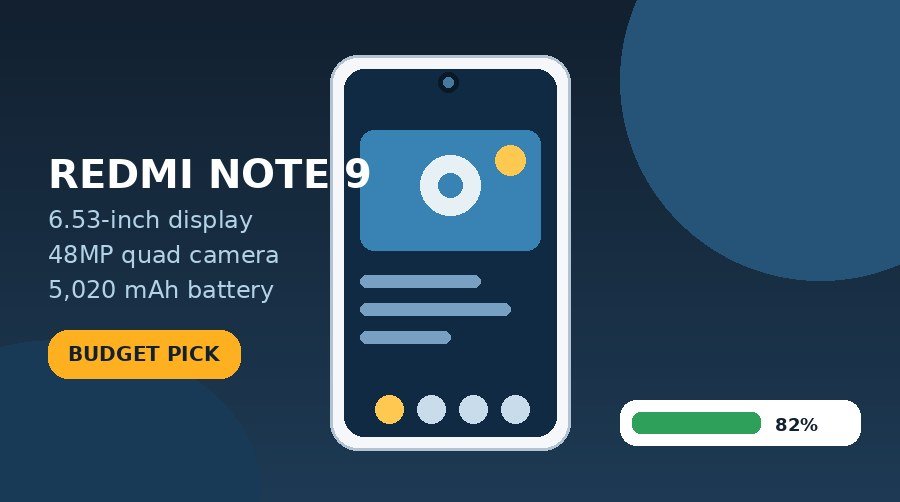
The Redmi Note 9 runs on the MediaTek Helio G85, a 12-nanometer octa-core chip with two fast Cortex-A75 cores at 2.0 GHz and six efficient Cortex-A55 cores at 1.8 GHz, paired with Mali-G52 MC2 graphics. The global model came with 3GB of RAM and 64GB of storage or 4GB of RAM and 128GB of storage. Storage uses the older eMMC 5.1 standard, which means slower app installs, but a dedicated microSD slot lets you add up to 512GB without giving up your second SIM card. The full Xiaomi Redmi Note 9 specifications on GSMArena list the same core hardware.
| Specification | Xiaomi Redmi Note 9 |
|---|---|
| Display | 6.53-inch IPS LCD, 1080 x 2340, Full HD+, 395 ppi, Gorilla Glass 5, 60Hz |
| Processor and RAM | MediaTek Helio G85, octa-core, Mali-G52 MC2 graphics, 3GB or 4GB of RAM |
| Storage | 64GB or 128GB eMMC 5.1, dedicated microSD slot up to 512GB |
| Rear cameras | 48MP main, f/1.79 + 8MP ultra-wide, f/2.2 + 2MP macro + 2MP depth |
| Front camera | 13MP, f/2.25, in a punch-hole cutout at the top left of the screen |
| Battery and charging | 5,020mAh, non-removable, 18W wired charging over USB-C, 9W reverse charging |
| Software | Android 10 with MIUI 11 at launch, last major update Android 12 with MIUI 13 |
| Security and sensors | Rear fingerprint sensor, face unlock, infrared blaster, 3.5mm headphone jack |
| Connectivity | 4G LTE, no 5G, Wi-Fi ac, Bluetooth 5.0, NFC on most global units, FM radio |
| Build and size | 162.3 x 77.2 x 8.9 mm, 199 g, plastic back, splash protection but no IP rating |
The screen is still one of the phone’s best features. The 6.53-inch IPS LCD panel has a resolution of 1080 by 2340 pixels, about 395 pixels per inch, so text looks crisp and photos look detailed. The 13MP front camera sits in a small punch-hole cutout at the top left. Brightness is the weak point: the panel reaches around 450 nits in typical use, which is fine indoors but can look washed out in bright sunlight. There is no high refresh rate, so scrolling runs at a standard 60Hz. Gorilla Glass 5 protects the front, while the back is glossy plastic. The phone also keeps a 3.5mm headphone jack and an infrared blaster.
How good is the Xiaomi Redmi Note 9 camera?
The camera is the phone’s headline feature, and the one most likely to disappoint if you expect too much. The rear setup has four lenses: a 48MP main camera with an f/1.79 aperture, an 8MP ultra-wide camera with a 118-degree field of view, a 2MP macro camera and a 2MP depth sensor, plus a single 13MP front camera. In bright daylight, the main camera takes pleasant, detailed photos with natural colors. Low light is where the age shows most: with no optical image stabilisation, night shots depend on software night mode, which can blur if your hands move.
How long does the Xiaomi Redmi Note 9 battery last?
Battery life is the Redmi Note 9’s strongest suit. The 5,020mAh battery is large even by 2026 standards, and reviewers at launch found it easily lasted a full day and often stretched into a second day with moderate use. The catch is age. Every battery loses capacity with time and charge cycles, and a phone that left the factory in 2020 now has a six-year-old cell inside it. If the phone drops quickly from 30 percent to zero, or the back panel feels swollen or lifted, walk away — a swollen battery is a safety risk. Charging is slow: 18W wired charging takes roughly two hours to fill the battery from empty.
How does the Helio G85 perform in 2026?
The Helio G85 was a solid budget chip in 2020, and it remains usable for everyday tasks in 2026, but its limits are easy to feel. With 4GB of RAM, you can switch between a handful of apps without constant reloading. If you are choosing a model, buy the 4GB one, and pick the 128GB storage model because 64GB fills up fast. For a similar big-battery budget experience, our guide to the Vivo Y31 is worth a look before you decide. Light games run well, but demanding games at high settings will struggle, and newer games may not run smoothly at all.
Does the Xiaomi Redmi Note 9 still get updates?
No. Xiaomi ended software support for the Redmi Note 9, and no new updates are expected. The phone launched with Android 10 and MIUI 11, and its last major update was MIUI 13 based on Android 12, which reached global units in late 2022. Security updates ended in May 2023, per Xiaomi’s support list, and the phone will not receive HyperOS, Android 13 or any later version through official channels. But without security patches, known vulnerabilities stay unpatched, and banking apps are usually among the first to demand a newer system.
How much does a used Xiaomi Redmi Note 9 cost in the US in 2026?
There is no reliable US price to quote, and that is itself an important part of the answer. Because the Redmi Note 9 was never officially sold in the United States, there is no US list price, no US carrier price and no established US used market for it. One tracker shows about $224 for a 3GB and 64GB global unit in November 2026, but that reflects overseas stores, not a verifiable US sale price. If an imported six-year-old Redmi Note 9 costs anywhere near $199, it is a bad deal: $199 buys a new Moto G 2025 or Samsung Galaxy A16 5G with a warranty and years of updates.
Should you buy the Xiaomi Redmi Note 9 or a US alternative instead?
For a US buyer in 2026, buy the US alternative. The Redmi Note 9 was a very good budget phone in 2020, but its case collapses on the three things that matter most for a daily phone: security updates, carrier compatibility and warranty. A phone with no security patches since 2023, partial US band support and no official repair network is a gamble, and the savings over a new budget phone are too small to justify it.
The Moto G 2025 is the closest like-for-like replacement. It launched in the US at $199 with a 6.7-inch 120Hz display, the Dimensity 6300 chip, 4GB of RAM, 128GB of storage, a 5,000mAh battery and 30W charging, running Android 15. The Samsung Galaxy A16 5G is the better choice if you plan to keep your phone for a long time. It launched in the US at $199.99 with a 6.7-inch Full HD+ Super AMOLED display, a 5,000mAh battery, and six generations of Android upgrades plus six years of security updates. If you want another established budget option, our guide to the Samsung Galaxy A12 shows what Samsung’s budget line offered a generation earlier.
What should you check before you buy a used Xiaomi Redmi Note 9?
Start with the software, then test the hardware in person. Open the settings and check the Android version and the security patch date: a fully updated global unit should show Android 12 with MIUI 13 and a patch from late 2022. Then charge the phone to full and watch how fast it falls during twenty minutes of video; a sharp drop is a sign of a worn battery. Test the cameras, fingerprint sensor, face unlock, headphone jack, USB-C port, speakers, Wi-Fi, Bluetooth and GPS. Our guide to the Nokia C3 shows the same checks applied to another affordable phone from the same era.
Frequently asked questions about the Xiaomi Redmi Note 9
Is the Xiaomi Redmi Note 9 still worth buying in 2026?
Not as a main phone in the US. It was never officially sold in the US, its security updates ended in May 2023, it stops at Android 12. It can still work as a cheap spare phone, but a new Moto G 2025 or Samsung Galaxy A16 5G at about $199 is a far safer buy.
What is the last update for the Xiaomi Redmi Note 9?
The last major update is MIUI 13 based on Android 12, which reached global units in late 2022 with a September 2022 security patch. Xiaomi’s support list records security updates for the Redmi Note 9 as ending in May 2023, and the phone will not receive HyperOS or Android 13 through official channels.
Does the Xiaomi Redmi Note 9 work in the US?
Sometimes, but not reliably. It is a 4G-only imported phone with no US certification, partial US band support — about five of fourteen tracked 4G bands on the global model — and no band 71 for T-Mobile’s wide rural coverage. It may work on T-Mobile or AT&T in cities, but it can be refused activation and lose signal outside cities.
How much is a used Xiaomi Redmi Note 9 worth in the US?
There is no reliable US used price to quote because the phone was never officially sold here and has no established US resale market. As a guide, if any US listing approaches $199, do not buy it — that money buys a new Moto G 2025 or Samsung Galaxy A16 5G with a warranty and years of updates.
Is the Xiaomi Redmi Note 9 good for gaming?
It is fine for light and casual games, but not for demanding titles in 2026. The Helio G85 and 4GB of RAM handle puzzle, card and casual arcade games well, and popular battle royale games run at modest settings. Demanding games will stutter, and the older eMMC storage makes large games slow to load.
The Xiaomi Redmi Note 9 earned its reputation honestly: a sharp 6.53-inch screen, a versatile 48MP camera, a huge 5,020mAh battery and a fair price made it one of the best budget phones of 2020. Six years later, the hardware still impresses in places, but the software has stopped, the US carrier fit was never good, and the value has moved on to new budget phones that cost about $199 with years of updates ahead of them. If you already own one, enjoy it as a spare phone. If you are buying now, buy the phone with a future.
Sources: specifications via GSMArena; launch and review findings via Pocket-lint, Trusted Reviews and Notebookcheck; final software and security end date via Xiaomi firmware records and Xiaomi’s support list; US band coverage via Kimovil frequency data; US alternative prices and support terms via Motorola and Samsung launch pricing as reported in June 2025 comparisons. Facts verified November 24, 2026.